When a Civic Tech Company Builds With Government
There's a pattern in civic tech that often repeats itself: a company builds a product it thinks the government needs, then spends years trying to shorehorn it into workflows it was never designed for. The product might be elegant. The intentions might be genuine. But the gap between what was built and what the government actually experiences day-to-day is vast.
At GovSkills, we decided to do something different. Before we locked in a single feature, we went and listened.
This past fall, we launched our Design Partnership Program. It was a three-month engagement with government HR professionals from across the country who agreed to do something most people in their position don't have time for: tell us exactly what's broken, what they need, and what they'd never use in a million years.
The Partners Who Shaped This
We worked with three partner organizations during this Design Partnership Program.
Crystal and Laurie from Muskegon County, Michigan: a mid-size county that had watched its average time-to-fill balloon to 132 days. Not 132 days to hire someone exceptional. 132 days to hire anyone. They came to us not looking for another tool, but for something that could help them get ahead of a process that kept outrunning them.
Steve from Mono County, California: a seasoned HR leader who had previously overhauled recruiting in Nevada County and was now bringing those hard-won lessons to a smaller, resource-constrained rural county.
Andrea from NACo (the National Association of Counties): where she operates as a team of one, managing all recruiting for an organization that, as she put it, is "like an onion with many layers."
These aren't edge cases, they represent what government HR actually looks like: under-resourced, overlooked, and expected to compete for talent in a private sector that plays by entirely different rules.
Government Loses Candidates Before the Conversation Even Starts
The first thing that struck me across every conversation was how deeply the problem starts with the job description itself.
Steve came into our sessions with receipts. In Nevada County, CA, he had undertaken a full overhaul of all 450 job descriptions using Textio, a platform that scores postings for clarity, bias, and appeal. Government job descriptions that had been actively recruiting real candidates were scoring 18 out of 100 on basic readability.
Crystal and Laurie described a very similar problem. Job descriptions in their county felt clinical, dense with requirements, heavy on bullet points, "bombarding candidates with cold technical information" rather than giving someone a reason to apply. And the titles themselves often worked against them: a role called "Manager of Project Management" reads like a compliance artifact, not an opportunity. They knew candidates were leaving before they got far enough to understand what the job actually was.
Andrea's experience at NACo showed what this costs in practice. A data architect role sat open for months. Over 100 resumes came in. Five were actually qualified. The posting wasn't clearly communicating what the role required or who it was for and for a team of one, a flooded pipeline of unqualified applicants isn't just a frustration. It's a real drain on time that should be spent on the people worth calling.
What all three of them described points to the same structural challenge: government job descriptions are written for civil service compliance, not for candidates. The language that satisfies a classification system isn't the language that makes a strong candidate stop scrolling.
That's what inspired Job Translation, a GovSkills feature that takes existing government postings and translates them into compelling, human-readable descriptions that reflect what the role actually involves and why someone would want it. Steve's insight about keeping the compliance language intact while building a separate candidate-facing version is baked into how we built it. When Andrea saw it in action, her response was immediate: "That would be amazing."
The Hidden Cost of Slow Hiring
Here's something the private sector knows and the government rarely acts on: once a candidate starts a job search, you typically have 30 to 60 days before they're gone.
Steve has watched this play out across two counties. At Nevada County, he built a recruiting model fast enough to actually compete, early adopters were able to hire in 28 days. The initial pushback from staff was predictable: *We can't do it in less than 90 days." His response: prove it.
Crystal and Laurie are working within the same urgency, with a 132-day average that reflects not a lack of effort, but the reality of civil service structures, classification systems, and governance requirements that simply don't have private sector equivalents. They've learned to think about the problem differently: the goal isn't just speed. It's retention. A role filled quickly by someone who leaves in six months is worse than a longer, more deliberate hire.
The Value Government Has
But one thing was consistent across all three conversations: the government doesn't tell candidates what it's actually worth to work there.
Laurie leads with it at career fairs, 38 paid days off in the first year alone. "Unheard of" is how she describes people's reactions. Her county had started rolling out annual total compensation statements to existing employees, and the response was immediate: they loved it. The insight she kept coming back to was doing the same thing for new candidates, showing the full picture before the salary comparison ever happens.
Steve has made the same case to law students: an $80,000 government salary with loan forgiveness and paid leave puts more money in your pocket than a $120,000 private sector position once you run the actual numbers.
And Andrea noted something easy to overlook: at NACo, benefits aren't proactively shared with candidates unless they ask. Missing an opportunity to tell the whole story of a job.
GovSkills is building tools to help the government tell this story including a Total Compensation Visualization so folks can see the net dollar value, not just the salary line. The goal isn't just faster hiring, it is meeting candidates where they are and making the case for public service in language that actually lands.
What Better Information Makes Possible
At its core, what our design partners kept asking for was better data.
Crystal was direct about it: "The Board of Commissioners eats data analytics for breakfast." Her team needed more than anecdotal evidence to make the case for compensation changes or process improvements. They needed market context (peer county, private sector and role-level comparisons) to have grounded conversations about where Muskegon was genuinely competitive and where candidates might be weighing other options.
Andrea needed something similar. Without metrics, it was hard to distinguish whether a long time-to-fill was a pipeline problem or a position problem.
This is what shaped Comparison Insights, a GovSkills feature that gives HR teams real market context so those conversations can happen earlier and with more clarity. For Crystal and Laurie, that kind of visibility is the difference between reacting to time-to-fill and getting ahead of it.
What Building WITH Government Looks Like
I want to be honest about what we learned from these three months, because I think it applies beyond GovSkills.
Listening to the government isn't the same as watching the government. You can audit applicant tracking data, read white papers about public sector HR, and study workflows from the outside. You'll learn things, but you won't learn what Steve knows from personally rewriting 450 job descriptions and tracking every score. You won't understand what Andrea experiences when she's the only person standing between an open role and a qualified hire, trying to make a layered job description land with the right candidate. You won't feel the weight of what Crystal and Laurie are working within when they talk about what it really takes to compete for talent without the same flexibility the private sector offers.
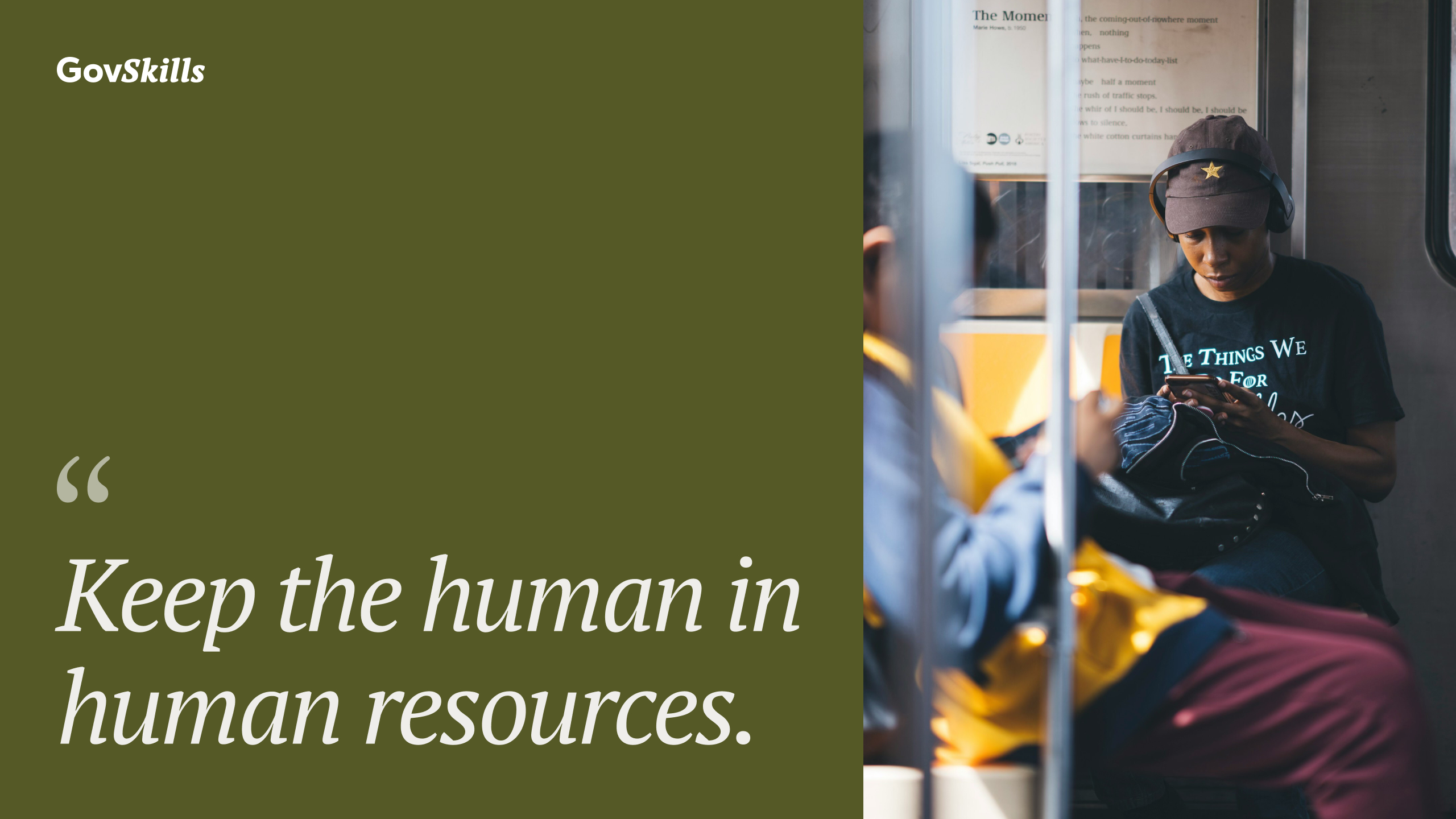
Crystal put it plainly: "Recruitment is relationships." And something else she said stayed with me: "Keep the human in human resources." The tools we're building aren't meant to replace judgment, they're meant to create more space for it, by taking the work that shouldn't require a human off the pile of work that does.
The features we built from this group aren't the result of guessing at what HR teams need, they are the direct output of public sector professionals telling us, in specific terms, what would actually change their work.
What Comes Next
We're continuing to develop GovSkills with and for the people doing this work. The Design Partnership Program is how we stay honest and grounded in the actual experience of government HR, not a version of it we've imagined from the outside.
If you're in government HR and you recognize yourself in any of these stories, if 132 days sounds familiar, if you've ever watched 100 resumes arrive and found five worth calling, if you're one person trying to do work that could fill a team, we'd like to talk with you.
The goal isn't just a better product, it is a public sector that can actually hire the people it needs to serve its communities well.