5 min read

Two conferences, two years, nearly 175 government agencies. The sticky note board doesn't lie.
At the NACo Annual Conference in New Orleans, we set up a sticky note board at booth 447 and asked one question.
What's your hardest job to hire for?
Nearly 100 county governments answered. From small rural counties to large metro ones, from the Mountain West to the Southeast, the same roles kept appearing. The board filled up faster than we expected, it always does.
Here's what county governments told us in 2026, and why the comparison to last year matters.
What NACo 2026 said
Law enforcement came in first, and it wasn't close.
Deputies, corrections officers, dispatchers, and probation officers combined for roughly 40% of all responses. Individual notes named specific contexts: a county in New Mexico. Gahanna, Ohio. The pattern was national.
But the second-place answer is the one that deserves more attention.
Behavioral health. Mental health clinicians, licensed social workers, master's level clinicians, child protective services specialists. These roles came in at 23% of all NACo responses, making them the second most-cited category by a wide margin.
Behind those two, the board looked like this:
IT and cybersecurity (12%): generalist IT staff, agency IT portfolio managers, software developers
Engineering and public works (10%): civil engineers, public works directors, signals engineers, highway foremen
Nurses and EMS (9%): detention nurses, paramedics, public health nurses
Social workers and case managers (8%)
Corrections officers (7%)
Dispatchers and 911 operators (6%)
County-specific roles also appeared that you won't find on a city HR conference board: assessors, probate clerks, flood coordinators, county managers, treasurers, comptrollers. These are functions that exist largely at the county level by statute, and the hiring challenges that come with them are equally county-specific.
This isn't the first time we've run this exercise
At the PSHRA Annual Conference in 2025, we asked the same question. Roughly 75 government agencies answered, a broader mix that included cities, special districts, airport authorities, and counties.
Some things haven't changed.
Public safety was the #1 answer at PSHRA too. Law enforcement and fire combined for roughly 30% of that board. The consistency across two different audiences, a year apart, points to something structural. These aren't hard-to-fill roles because of a bad hiring cycle. They're hard to fill because the qualified candidate pool is structurally small, the credential requirements are real barriers, and the competition for lateral talent is fierce.
Engineering and infrastructure showed up on both boards in significant volume. At PSHRA, the audience mix meant building inspectors, electrical inspectors, and engineering technicians were more prominent, reflecting city and special district functions. At NACo, it was civil engineers and public works directors. Different titles, same underlying problem: licensed engineering talent is being outcompeted by private sector salaries, and government job postings often don't communicate what the role actually is in language engineers recognize.
Some things shifted.
Behavioral health went from 7% of PSHRA responses to 23% of NACo responses.
That jump is real. It's not a sampling artifact. It reflects a genuine difference in what counties carry that cities often don't: county jail mental health programs, mental health courts, adult outpatient services, and CPS caseloads at scale. The licensed clinician workforce (LCSW, LPC, MFT, clinical psychologist) was already undersupplied before COVID accelerated burnout across the behavioral health sector. Counties are now competing for those workers against hospitals, private practices, and nonprofits that can often pay more and carry less institutional friction.
IT also shifted upward, from roughly 4% at PSHRA to 12% at NACo. Deepening cybersecurity obligations at the county level, including CISA critical infrastructure requirements, are likely a factor. The private sector salary gap in IT is well documented. What's less discussed is how often government IT roles are titled in civil service classification language that technology professionals don't search for.
What was unique to each audience.
PSHRA's broader mix of government types produced roles that almost never appear on county boards: building inspectors, firefighters, librarians, utility workers, crossing guards, custodians, dog wardens, lifeguards. Those are real and pressing municipal and special district hiring challenges. They simply reflect a different set of government functions.
NACo's county-only audience produced roles you won't find at a city HR conference: assessors, probate clerks, county managers, flood coordinators, legislative liaisons. County government has a distinct hiring market, and treating it the same as municipal recruiting is a strategic mistake.
The thread that runs through both boards
Look at the hardest-to-fill roles across both conferences and one pattern holds regardless of government type or year.
Nearly every role requires a credential.
POST certification for law enforcement. Professional Engineer licensure for civil and structural engineers. LCSW or LPC for licensed clinical social workers. EMT-P for paramedics. AICP for planners. CDL for equipment operators. Building inspector certification. Master's level clinical licensure.
The job boards most government HR teams are using today have no mechanism for filtering on these credentials from the candidate side, and no way to surface roles to candidates who hold them. A county posts a master's level clinician position using its civil service classification title. A licensed clinical social worker in the same metro searches for jobs using terms from her field. They never find each other.
That's not a compensation problem. It's a matching problem. And it repeats across the entire board.
Three things that would move the needle
Based on two years of this exercise, across nearly 175 government agencies, here's what the data actually points to.
Translate the posting before you publish it. "Licensed Clinical Social Worker II" is a classification. "Mental Health Case Manager, County Jail Services" is a job description. The difference between those two titles is the difference between a flooded inbox of unqualified applications and a pipeline of people who understand what they're applying for. This applies to IT titles, engineering titles, and law enforcement titles just as much.
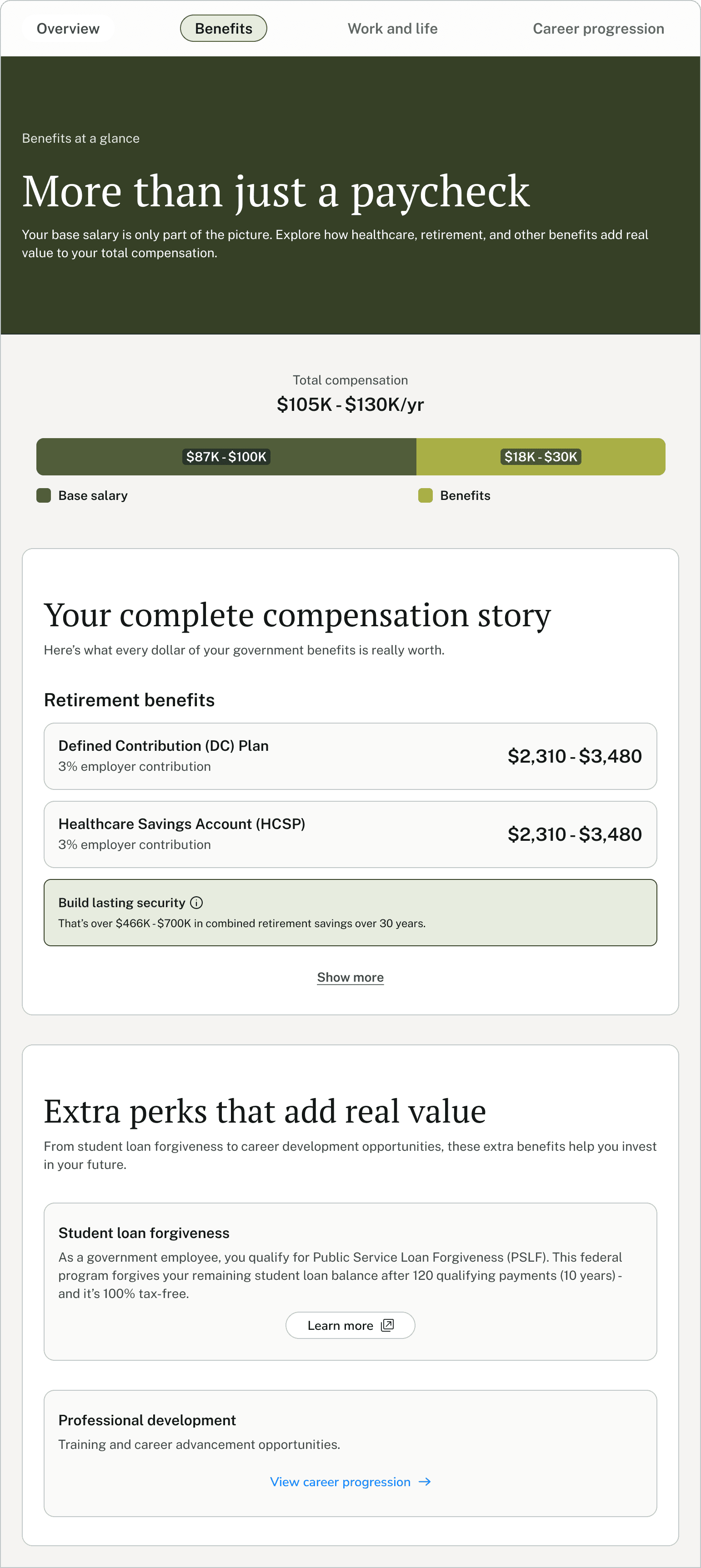
Lead with total compensation, not just salary. For IT, behavioral health, and engineering roles in particular, government offers something the private sector genuinely doesn't: defined benefit pensions, job security, and for roles that qualify, Public Service Loan Forgiveness. A licensed clinical social worker with a master's degree and student loan debt is leaving real money on the table by ignoring government positions if no one tells her about PSLF eligibility. That's a sourcing failure, not a candidate preference.
Stop treating government recruiting as one market. A city parks department and a county behavioral health division are not recruiting from the same pool, against the same competition, with the same selling points. The PSHRA and NACo data make this concrete. Segment your strategy by government function, not just government type, and the right candidate audiences become much clearer.
A note on methodology
This research comes from two booth activations at national government HR conferences. Attendees responded voluntarily. At PSHRA 2025, roughly 75 government agencies participated, including cities, counties, special districts, and authorities. At NACo 2026, roughly 100 county governments participated.
The data is qualitative and the counts are approximate. This is not a controlled survey. It is a direct, unprompted answer from nearly 175 public sector HR professionals and government leaders about where their recruiting pain actually lives.
We think that's worth something.
GovSkills helps government HR teams find, attract, and hire qualified candidates across all government roles. Learn more at govskills.io.